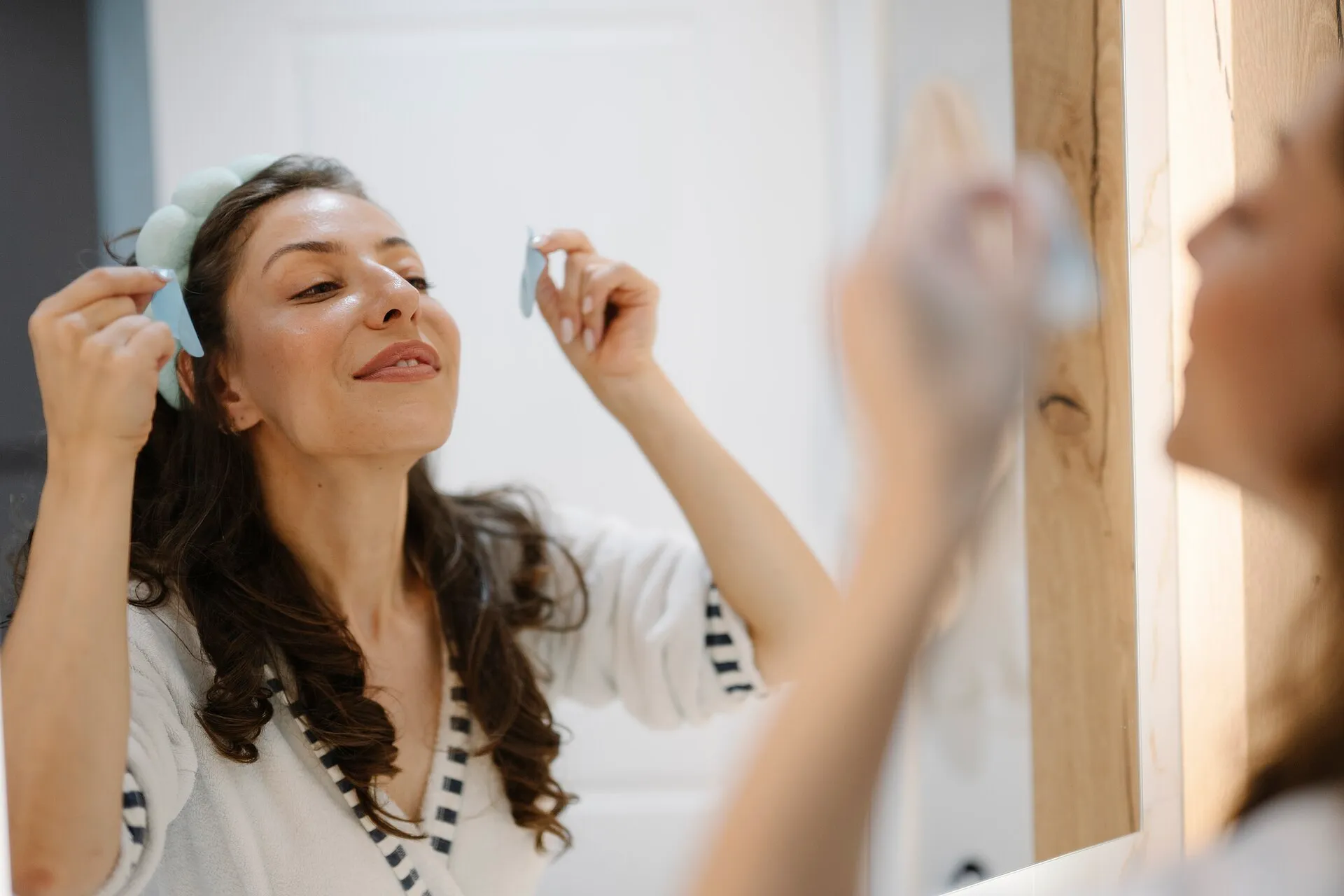
A gua sha tool doesn’t do anything a pair of hands couldn’t, technically. What it does do is force a slower pace - it’s hard to rush a stone across your own face - which might explain why the minute it takes has become the actual habit worth keeping.
The stone is a timer, not a treatment
Most skincare steps are quick by design: apply, done, move on. The bottle is built for a rushed morning, and the instructions never ask for more than a few seconds of anyone’s attention. A flat piece of quartz asks for more, and it asks without saying anything.
Speed is the first thing it takes away
Drag a stone too fast across skin and it skips, catches, and stings. The hand slows down to stop that from happening, and the correction arrives somewhere below deliberate thought - which is exactly why it works where an instruction to relax does not. Nobody has to decide to be calm. They just have to stop the tool from dragging.
Nobody needs a stone to moisturize. They need a reason to slow down for sixty seconds, and the stone is a good enough excuse.
Sixty seconds is the whole ask
One minute, once a day, at a sink someone is already standing at. Nothing is added to the calendar and nothing is given up, which is most of the reason the habit outlives the more ambitious routines it sits next to. The ceiling is low on purpose. So is the floor.

Building it so it survives a bad week
Any routine works in the first week. The interesting question is what happens in the fourth, on a morning that started badly, when the version of the habit that gets done is whatever takes the least effort to begin.
Put it where the moisturizer already lives
A habit that requires opening a drawer is a habit with a door in front of it, and the door is usually enough to end it. Leave the stone out, next to the thing it follows. Anything that has to be fetched, unpacked, or remembered has already lost the argument.
Keep the bar embarrassingly low
One minute. Not five, and not a named sequence of strokes in a fixed order that has to be looked up. Design the habit around the worst day rather than the best one, because the worst day is when the elaborate version quietly gets dropped and never comes back.
Stop measuring the jawline
Depuffing, drainage, a sharper line along the jaw - the claims vary and mostly outrun what anyone can demonstrate. Judge the minute on whether it happened, not on what it delivered. A habit measured by its results comes with a reason to quit built into it.
What the research will and won’t support
The honest summary is that the evidence is thin, and that the thinness is not an argument against doing it. It is an argument for being clear about what is being bought.
The claims that outrun the proof
Lymphatic drainage is the phrase doing the heaviest lifting and carrying the least weight. Contouring effects are largely temporary fluid movement, visible for an hour or two after a session and gone by lunch. Lasting structural change to a face is not on the table, and no honest reading of the literature puts it there.
The one effect that holds up
The part that survives scrutiny is unglamorous: slow, repetitive, self-directed touch for a minute lowers self-reported tension in the moment it happens. That is a small finding. It is also the entire case, and it is enough.
The part nobody puts on the box
Strip out the stone and the claims and what remains is a minute a day that cannot be done quickly. That is a strange thing to have to buy, and stranger still that it works better as an object than as an intention. But a tool sitting on the counter is a reminder with a shape, and a reminder with a shape gets used.
Expect more of this. The self-care products worth watching are the ones judged less by what they claim to do to a face and more by whether they successfully carve out a slow, device-free minute in a routine built to be rushed - the ritual mattering more than the thing it is built around.